Six chefs, one archaeologist and a pig that started cooking at four in the morning. What live fire actually puts on the plate at Chefs on Fire, in Cascais.
by Gizane Campos for Luxeat Guide.
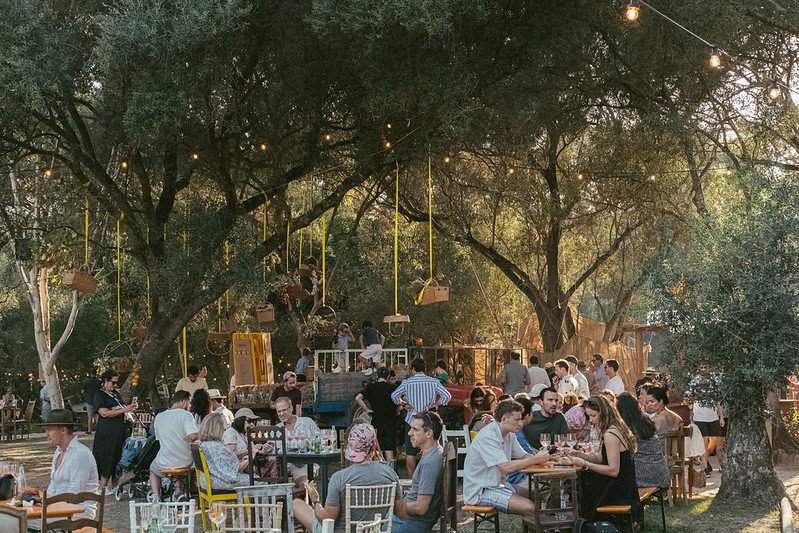
For one weekend every September, Parque Marechal Carmona smells of woodsmoke, pine resin and something sweet catching on a grill you can’t quite see. Chefs on Fire leaves exactly one souvenir, and you take it home in your hair and clothes.
The festival runs on a rule so simple it sounds like a dare: everything is cooked over embers, ash or open flame. There is no induction hob, no combi oven humming in a corner, holding a fillet at a chosen degree for as long as anyone likes. For two days, the equipment that makes a modern restaurant kitchen predictable isn’t there, and the chefs are left with the oldest tool we have and whatever they have learnt about controlling it.
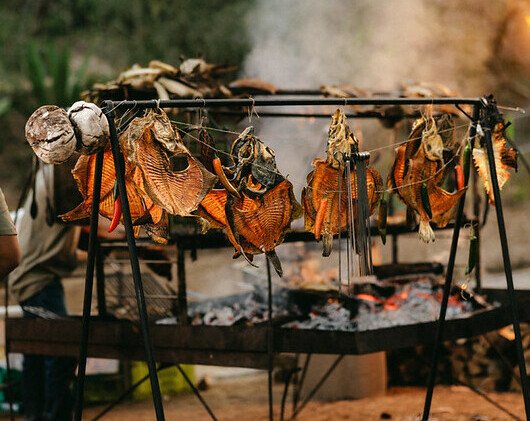
Luxeat sent me with one question, and I put it to every chef I could pull away from a fire for ninety seconds: what does fire give a dish that nothing else can?
I wasn’t after “smoky”, anyone can taste smoky. I wanted to know whether these cooks think of fire as a method, the way an oven is a method, or as something closer to salt: a thing you add, measure and can badly overdo.
I expected some overlap in their answers, but to my surprise, I got none. Home, transformation, unpredictability, smoke were some of their answers. One chef said a word that started out as “primal” and was corrected mid-sentence. Each answer arrived with its own small, specific theory attached.
Then I interviewed a seventh voice, an archaeologist who cooks the way people did tens of thousands of years ago and, it turns out, he had the bluntest answer of the lot.
“Primary”: João Rodrigues, Canalha
Canalha, in Lisbon, is built on a piece of the city that is quietly vanishing. In the middle decades of the last century, Galician immigrants brought a culture of charcoal grilling to Lisbon, and with it the carvoarias, the charcoal houses that once dotted its neighbourhoods. Rodrigues wants both halves of what that generation left behind: the comfort of a pot ticking over on the stove, and a fire cuisine that only comes out right with real technical control.
I caught him mid-service, and he never fully turned his back on the grill.
“Everything here comes down to the most basic element we have, one we can’t control with a switch or a dial,” he said. “You have to understand it, and that takes time. You have to observe, you have to feel, and to do that you need to be completely focused.”
He said primal, then corrected himself straight away: primário (primary). In Portuguese, the two words are a syllable apart, and he wanted the one that means first rather than the one that means wild. “You feel it on your skin, in your body, the smoke in your eyes, in the way you have to orient yourself around the fire. You step completely outside your comfort zone, trying to deliver something you’re carrying in your head, but through something you don’t control. It’s a brutal challenge. It’s also deeply satisfying. You feel connected to something at the base of things.”
I asked which was hardest to manage, ember, ash or flame, and he wouldn’t choose. “They’re all part of the same thing. Everything starts as fire, becomes ember, and ends as ash. And the ash controls the fire.”
The skill, as he describes it, is reading the whole cycle at once: which way the wind is blowing, whether the wood is stacked loosely enough to breathe, when the heat needs to spike and when to let it fall away. “Creating space for all of this is a constant discovery.”
What disarmed me was the admission at the end. After eight editions of the festival, he said, he is only now beginning to understand what this particular setting lets him do. Chefs don’t usually tell a journalist they’re still working it out. It made me trust everything else he said a little more.
“Hogar”: Mário Clemente, Alberca
Ask Mário Clemente for one word and he barely pauses. Hogar, home.
“At least in Spain, whenever you walk into a place and it smells of smoke, of wood, you always say, I’m home,” he told me, between turns of a tray of chorizo skewers. “Where I’m from, it was very typical to go out to the countryside with family, with friends, and gather around something cooking over embers.”
Clemente runs Alberca, his family’s restaurant in the old town of Trujillo. Before Alberca, he spent a year at Asador Etxebarri under Victor Arguinzoniz, the Basque cook most of his peers would name as the most influential live-fire chef working today.
“You don’t learn recipes there, because there aren’t any,” he said. “What you learn is the concept: valuing the product above everything. Product and fire.” He describes Etxebarri as a closed circle, with its own garden and its own animals. “The restaurant was the end point, but it started long before that.”
His own story is about scale, and it runs backwards. His parents ran a traditional menu-of-the-day place: fifteen euros, up to 120 covers a day, no ambition beyond feeding Trujillo well. When his father reached retirement age around the pandemic, Clemente came back from Madrid and took over. Alberca now seats twenty at most, for a single tasting menu of up to fifteen courses, with nearly twice the staff his parents employed. Fewer guests, more cooks. It’s a business plan that would make most accountants reach for a chair.
“We went from serving a hundred meals a day to twenty,” he said, and he still sounded slightly surprised by it.
The menus are named Brasas, Humo and Ceniza (embers, smoke and ash) and each is a different menu, not the same one with courses bolted on. The hardest to execute is the longest, Ceniza. “More technique, more work, more elaboration, more courses. In the end, it’s just more complex.”
“Transformation”: Lizandra Almeida, Pils
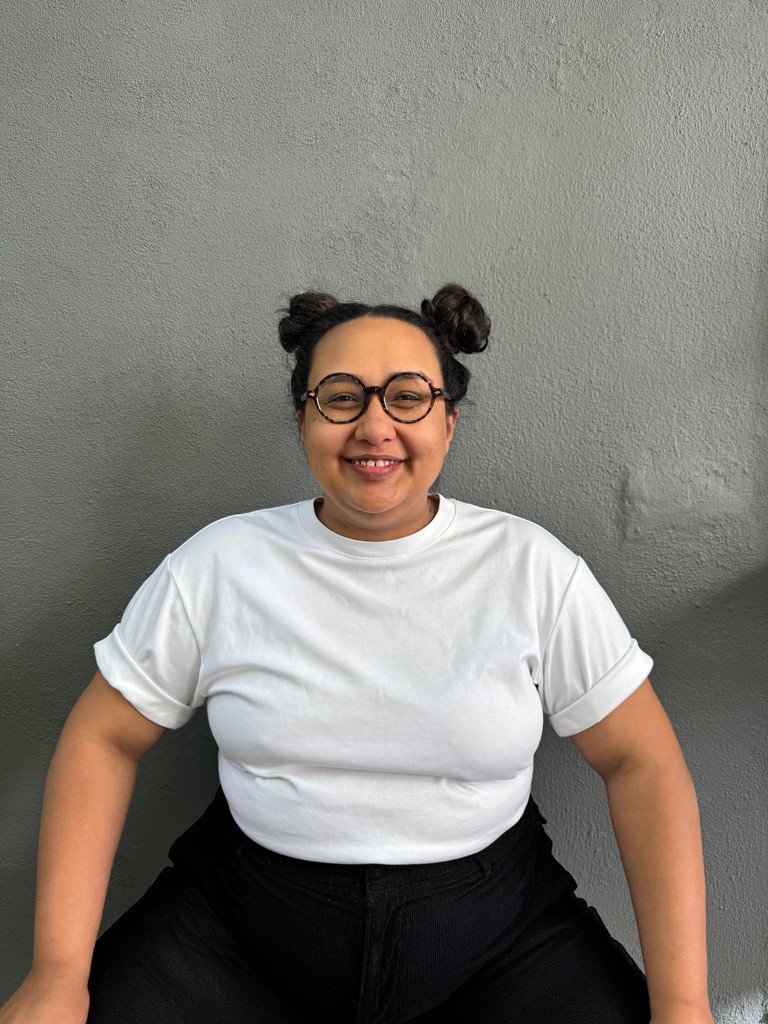
Liz Almeida turned the question over before answering. Transformation.
“I think fire is what set us apart from animals, somewhere in the evolution of early humans, millions of years ago,” she said. “Fire gives food a flavour no other method of preparation can. We have to use fire not just as a technique, but as an ingredient in its own right.”
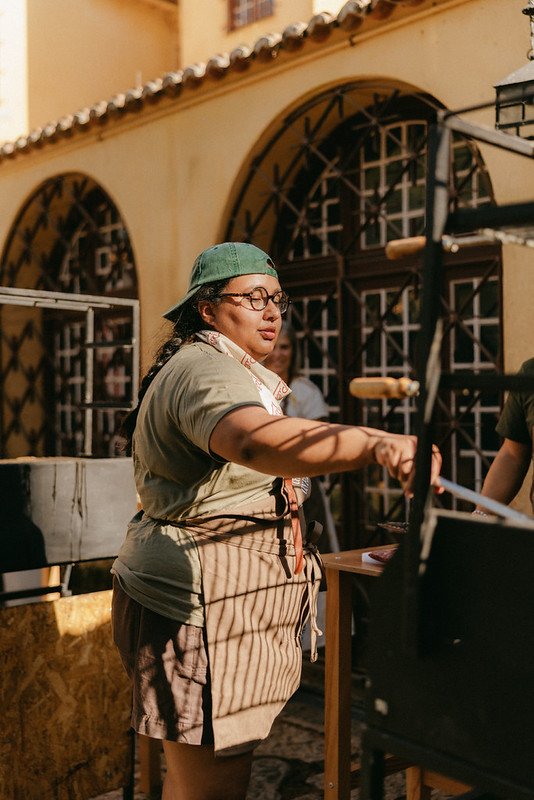
I can vouch for the second half of her answer personally, because Almeida is the reason why I can now say I’ve run a barbecue! She led a workshop at the festival, and I took my place at the grill for the first time with her standing at my elbow. Nothing caught fire that wasn’t supposed to, but I doubt she would hire me at her restaurant (I overcooked the meat!).
What she taught first was that “fire” is not one thing. Food held directly over a flame gets intense, uneven heat, and flares up when fat drips onto the fuel. Embers give radiant heat without the flames touching the food. Smoke carries whatever the burning wood releases. And ash, depending on what it is and how you use it, can shield an ingredient, slow down the heat, or add a faintly mineral edge of its own. They are four different ways of changing a piece of food, not four routes to the same smoky result.
Her festival dish was cupim: the fatty hump of zebu cattle, a cut Brazilians know and Portuguese diners mostly don’t, cooked slowly over embers and served with roasted pumpkin and mustard. She’d expected resistance. Cupim is also the Portuguese word for termite, and more than one visitor arrived at her stall braced for insects. “We had to explain to everyone that it’s something like a camel, a breed of cattle with a hump of fat on its back.”
Her choice between ember, ash and flame took less than a second. Embers. “And if you tell me they’re embers from wood, even more incredible.”
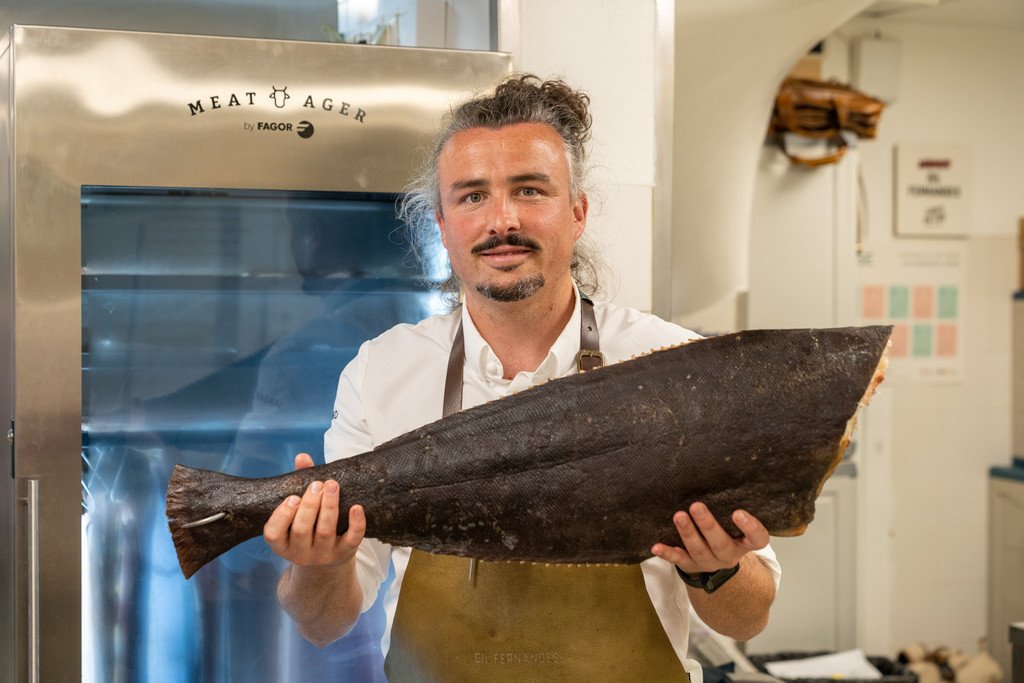
“Smoke”: Gil Fernandes, Fortaleza do Guincho
Fortaleza do Guincho is a 17th-century fort on the rocks at the end of the Cascais coast. It holds a Michelin star, and the Atlantic fills most of the view from its dining room windows. Gil Fernandes cooks there with the ocean by his side. I asked him to tell me in one word what fire does for food that no other technique does. His choice was the one I carried home on my clothes: smoke.
“It’s a different reaction. It’s not direct contact,” he said. “Smoke heats a dish at the same time it’s touching it, without the fish ever touching iron. It’s that temperature, with nothing else in between.”
His festival dish was Portuguese fish cooked in ash, with aubergine and pear. It looks simple and, by his own account, is very easy to ruin. “The biggest risk is the fish falling apart.” The fish is matured first, to firm it up and draw out some of its moisture. Then it goes into the embers, then onto the grill, and spends close to an hour in that in-between state, rising slowly to temperature. “Then you serve it fast, and with quality.”
A fish cooked in ash, explained by a chef whose word is smoke: that tells you how loosely these categories hold once you’re standing at an actual grill. He handed me a plate, then grabbed an ice-cold beer and drank it while taking a well-earned break. I must hand it to him, the technique is flawless and the flake spot on. The fish arrives warm and makes complete sense alongside the earthy aubergine and a bright, sweet pear purée.
Fernandes credits much of it to the water. “Guincho sits where the colder Atlantic meets a gentler, almost Mediterranean influence,” he explained, “and water at roughly 14 to 18 degrees feeds a dense web of life: algae, razor clams and other clams, all food for fish that grow fat on them. The sea there is shallow, too, which keeps the fish near the surface.” In his telling, that is where their texture and fat come from.
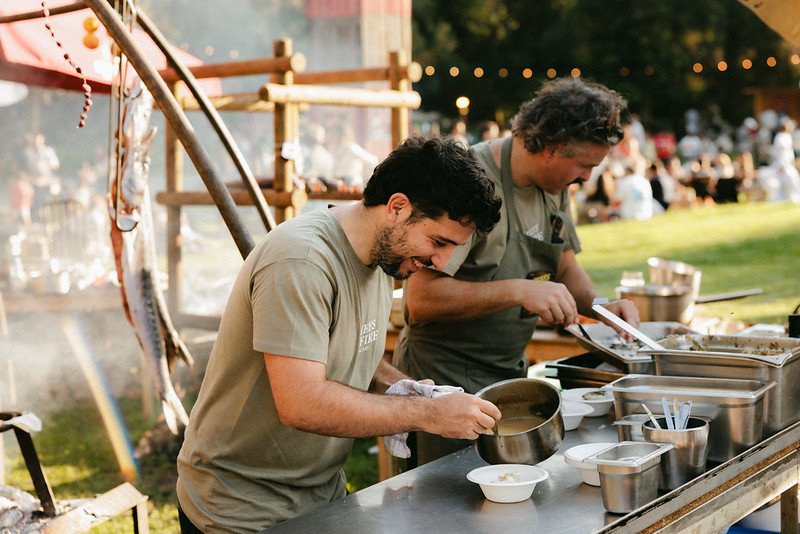
“Raised to the highest power”: Elísio Bernardes, Sea Me
Elísio Bernardes, who runs every kitchen under the Sea Me name in Lisbon, answered the one-word question with a formula. Elevação à máxima potência: raised to the highest power, the way you’d describe an exponent in a maths class. Then, as if the words were arriving faster than he could edit them: “Magic. Ascending. Our ancestors, earth and roots.”
He is uncompromising about what a fish loses when it skips the fire. “It should be forbidden not to pass it through fire,” he said. “It’s about what it loses by not going through it.”
That sentence wouldn’t survive a trip to Tokyo, and I suspect he knows it. So his dish argued the point better than the slogan did. Turbot, with black garlic miso toast and pennyroyal, a plate already loaded with intensity before a single ember touched it. So what does fire add to miso? Not char, he said. Calibration. Fire “sorts out the fine details. It helps balance everything and makes the whole thing singular.”
It was the most interesting idea I heard all weekend, and the hardest to check from the outside. Live fire is usually sold as the loudest thing on the plate. Bernardes uses it the way a cook uses salt, to make everything else come into focus. After one mouthful, I saw what he meant: the balance worked, and the pennyroyal’s mint managed to cut through the miso.
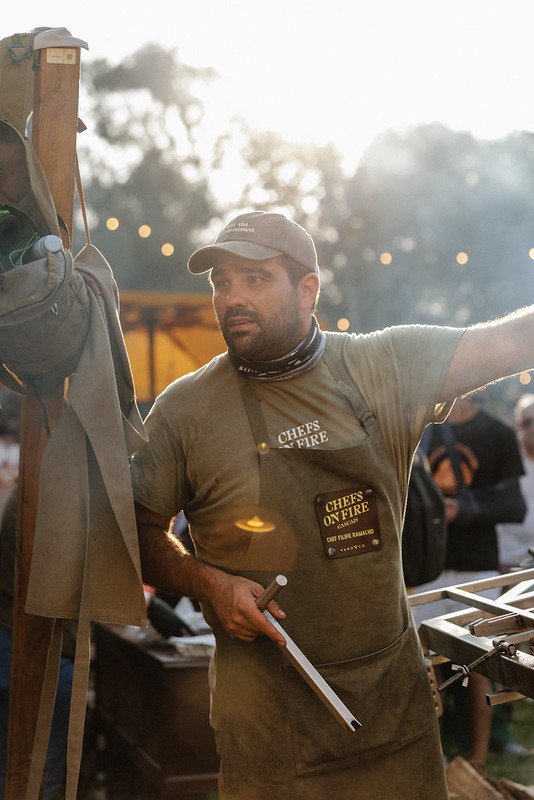
“Unpredictability”: Filipe Ramalho, Páteo Real
Filipe Ramalho had been on his feet since before dawn. He started roasting a whole pig at four in the morning, and still gave the most complete answer of the day.
“What fire gives an ingredient that nothing else can is unpredictability,” he said. “What I’m doing here today, tomorrow, somewhere else, will be different. The humidity, the wood, the ground itself, the minerals in the soil that’s burning, all of it changes things. A stainless-steel pot will always just be a thing cooked in a stainless-steel pot. Over fire, it’s always different. Humidity matters, temperature matters, even atmospheric pressure.”
Before sunrise, he was standing over the pig, watching its internal temperature refuse to climb. “The moment the first ray of sunlight hit the pig, the temperature started rising fast. It sounds insignificant, but it makes all the difference. Every element of nature is working on that fire, whether you notice it or not.”
Anyone who has tended a barbecue in a stiff wind knows a version of this. Professional skill doesn’t remove those variables.
His dish, the Sandes da Matança (pork, orange, fennel), carries a whole Alentejo tradition inside a sandwich. “Fire was how everything was done,” he said. “Not just smoking the sausages. Boiling the water to scald the pig, cooking the traditional dishes. Whatever needed to be made needed fire.” The matança do porco, the winter slaughter and processing of the household pig, is in its recognisable form roughly two hundred years old, he said, though killing pigs for food is far older.
The sandwich was the best-balanced dish of the festival. The fresh orange cut through the richness of the pork, while the fennel added a cool, aniseed freshness of its own. The soft Alentejo bread roll held, soaking up the juices as it went, the kind of bread made for exactly this job. It was the plate I kept thinking about on my way home.
On ember, ash and smoke, he went further into the mechanics than anyone else. Ember, he said, is the hardest to control. Ash and smoke both season the food, and not in the same way: the light, airborne ash that the wind carries into a pot seasons differently from the heavier ash that settles by the fire. He has evidence, or at least a source. For years he followed Dona Otávia, of a traditional Alentejo charcuterie house, who spent four decades perfecting her wood-smoking method. A study from the University of Évora, he said, later found that her approach (low, carefully managed heat, only in cold weather) didn’t carry the carcinogenic risk associated with badly managed smoke.

“Always an ingredient”: Pedro Cura, archaeologist
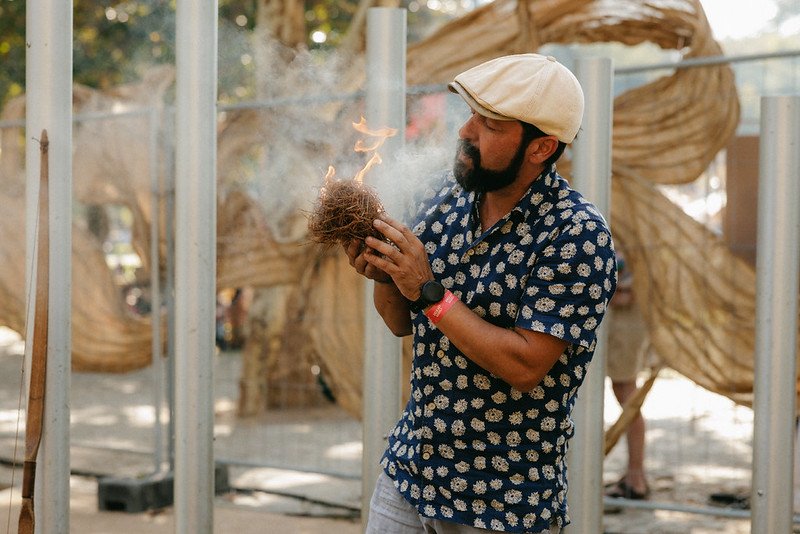
Pedro Cura, of Prehistoric Skills, works the opposite way from everyone else at the festival. The chefs push fire forward. He strips it back, butchering and cooking with only the tools the earliest humans had.
He is careful about where the story starts. Fire enters the diet, he told me, once it is genuinely controlled, which in his account means Homo erectus, around 1.9 million years ago. The primatologist Richard Wrangham makes a similar case in Catching Fire: cooked food is easier to digest, and the energy saved went to the brain, an organ that makes up about 2% of our body weight and burns roughly 20% of our energy at rest. The timeline is still argued over.
What fire changed first had nothing to do with flavour. Cooking killed pathogens in meat and softened tubers, and easier food reshaped the body itself, down to the teeth and the jaw. For something like a million years, the point was survival.
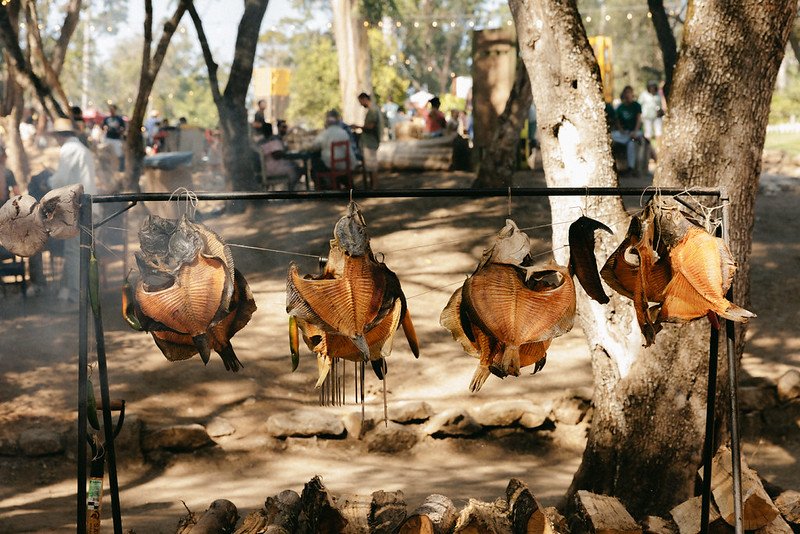
Then came the techniques, each with its own taste. Food over open flame picked up the ash and charcoal. A pit lined with hot stones could hold almost a whole animal at around 85 degrees for hours, until the meat went tender: slow cooking in all but name. Later came clay, where a fish keeps its moisture and its flavour comes through “much more truthfully”. Cooking for taste, he believes, took hold only with farming and pots, once eating well had become a mark of status.
On the question this piece is built around, though, he didn’t hedge. “From the very beginning, fire is always an ingredient. It always changes the flavour when food is put to the fire. It isn’t the means of transformation. It’s the ingredient that changes the taste.”
Playing with fire
Seven answers, and they don’t line up as neatly as a festival brochure would like. The disagreements are more telling than the agreements. Ask about embers and you get three answers: Almeida’s favourite, Ramalho’s hardest to tame, and for Rodrigues, not a separate thing at all. Bernardes would ban fish that never meets fire, while Fernandes cooks his without letting the flame touch it.
What nobody said was char and nobody offered “smoky” as a garnish. They described fire broken into its parts and kept like a pantry: ash that seasons, embers that steady a miso, menus named after the stages of a fire.
For most of human history, fire flavoured food whether anyone meant it to or not. These chefs have made that intention their whole job.